Drawn from the co-leaders' emails of August 13 and August 22, 2026. Their emails are the official word — this page just puts it in one place.
On this page
Arriving in WinnipegUpdated
The rendezvous is Town & Country Campground on Murdock Road, at the southeast corner of Winnipeg — relocated from Carberry after western-Manitoba flooding and road construction. Full hookups, 30 or 50 amp, water and sewer.
Your parking date, arrival window, and site number came to you individually by email in late August. Windows are staggered rig by rig, so go by the times in your own message rather than a general window. If you need to change your date, tell the co-leaders right away — earlier parking can be accommodated.
Advance parking on Friday, Sep 11 or Saturday, Sep 12 stays available if you arranged it, 1:00–4:00 PM each day, with early parkers on duty. You don't pay the campground directly — the caravan handles it.
The address, and why your GPS may fight you
56001 Murdock Road, Navin, MB. The campground warns that many GPS units don't recognize that address and will route you to the wrong end of Murdock Road. Their workarounds:
- Set the city to Dugald and enter 870 Murdock Road
- Some units file the campground under Springfield, MB
- Or just navigate to the coordinates: 49.8271425, -96.9808513
You're looking for the campground on the left as you head south on Murdock, past Tinkertown Amusement Park and what used to be Fun Mountain Waterpark.
Note the closure: the Murdock Road turn-off from the Perimeter Highway has recently been closed. Coming off the Perimeter you now have to continue past Murdock, take the exit for #1 Hwy West / Fermor Ave, and turn left onto Murdock from there. This applies whether you come in from the west on the TransCanada or up Highway 75 from the US.
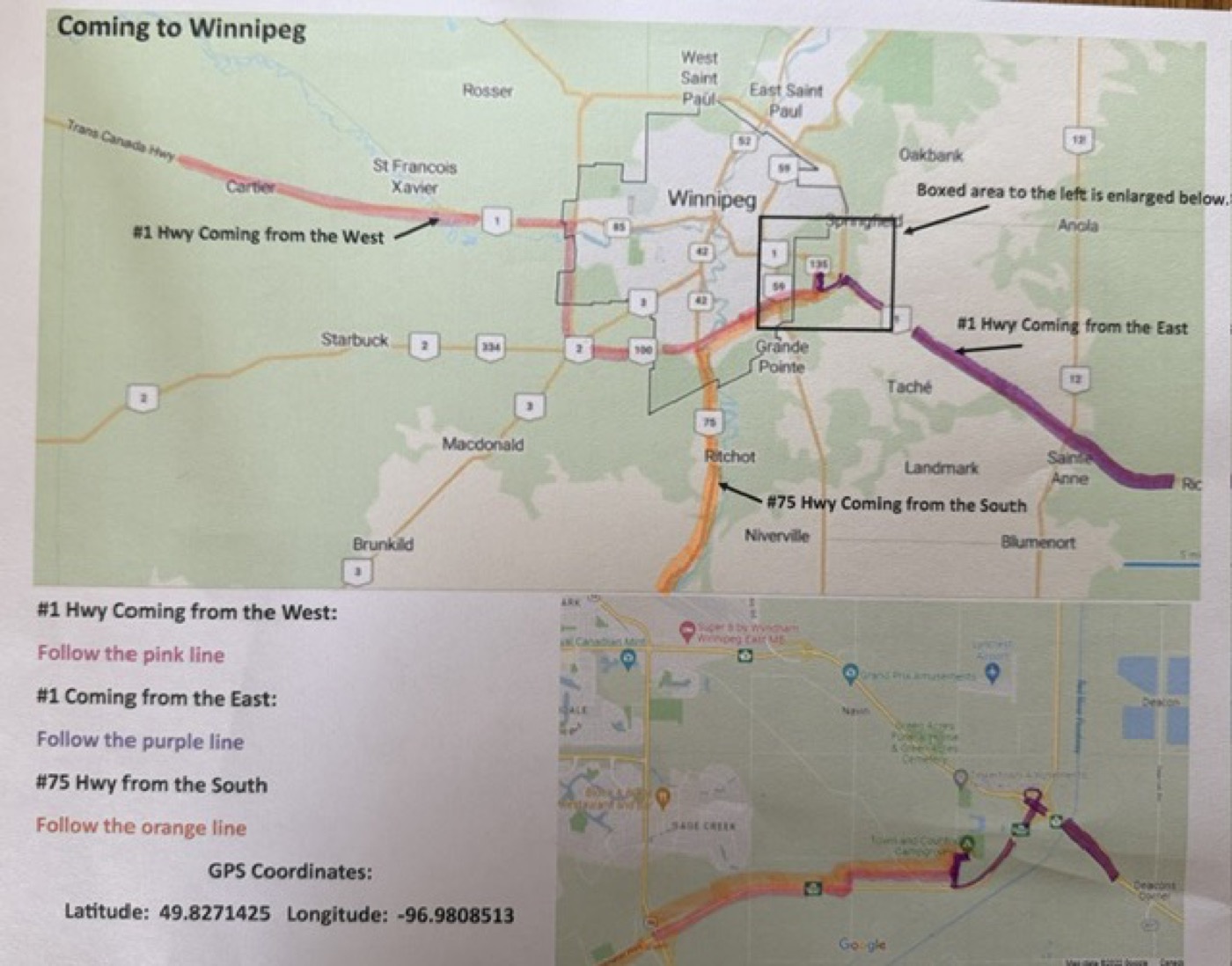
Town & Country written directions 71 KB
Manitoba cell coverage is good in town but thin between stops — worth having the directions saved offline before you're relying on them.
No open fires this yearRestriction
Manitoba is extremely dry. No open fires are permitted during the caravan, and burning restrictions are in force across many of the areas the route passes through. The caravan carries a propane fire pit and tank for group use, so evenings around a fire still happen — just not a wood one.
Expect to see wildfire damage along the way. The co-leaders are monitoring conditions and expect things around Thompson to be under control with much improved air quality by the time the caravan arrives, though nobody is guaranteeing weather. Manitoba's province-wide state of emergency has been lifted.
The Medical Emergency FormRequired
Every person needs their own form in their own sealed envelope, with their name on the outside. Not one per rig — one per person. These are collected on arrival in Winnipeg and travel with the co-leaders everywhere the caravan goes.
The envelopes are opened only in an emergency. Frontiers North Adventures will have access to the information during the Churchill portion of the trip. Your envelope is returned to you before you leave the caravan.
How to mark the envelope
The form itself asks for three things on the outside of the sealed envelope:
- Your name
- Your WBCCI number
- “MEI” printed in the upper left corner
The form asks for date of birth, WBCCI number, medical evacuation company and membership details, primary and secondary insurance with policy numbers, an emergency contact, your physician, and space for medical conditions, allergies, and a full list of current medications (prescription or not).
Medical Emergency Form 2026 108 KB
If you'd rather not deal with it at home, blank forms will be available to fill out when you arrive — but printing it now is easier than borrowing a pen in a parking queue.
The deeper dives
Several parts of the trip carry enough detail to live on their own pages, and each will grow as more information comes in from the co-leaders and Frontiers North.
The Community Service Project
What the caravan collects for northern Manitoba, where to find it on the road, and where it goes in Thompson and Churchill. Worth starting on now rather than later.
The Train to Churchill
VIA Rail from Thompson and back — the schedule, Economy Plus seating, baggage limits, motion sickness, food and alcohol rules, and security screening.
Winterizing in Thompson
Your rig sits five nights at McCreedy while you're in Churchill. Antifreeze, water lines, heat, and who helps.
The Tundra Buggy Lodge
Two nights parked out at Polar Bear Point — the bunks, the meals, the shared showers, and how the two full buggy days run.
Dog Sledding at Wapusk
Oct 6 in Churchill — Dave Daley's Métis cultural talk and a run behind the team, plus why you may be on a wheeled cart rather than a sled.
Staying connected
- Starlink — the co-leaders bring a system and everyone gets access. The password is handed out on arrival in Winnipeg.
- Cell service — good in the towns, very limited on the road between them. Plan on being out of touch on travel days.
- Over-the-air TV — available in Winnipeg, and nowhere north of it on the way to Thompson.
Easy things to forget
- Binoculars — the co-leaders called this one out specifically
- 2 gallons of RV antifreeze and an electric heater (see winterizing)
- Pillow and blanket for the train, unless you booked a sleeper (see the train)
- Snacks and beverages for the train — the snack car's selection is very limited
- Your Medical Emergency Form, filled out and sealed, one envelope per person
- Donations for the community service project
Volunteers wanted
Drone footage. The co-leaders would love aerial video of the caravan on the move. If you're bringing a drone, let them know — but read the next section first, because the Churchill end of the trip is closed to drones entirely.
The trip video. Last year's caravan went home with a video of the whole trip set to music — it was very well done, and they'd like one again this year. If you can put that together, volunteer.
Drones: no, at ChurchillProhibited
Frontiers North were asked directly whether guests may fly a small drone — even a sub‑250 g one — from the Tundra Buggy Lodge or out on the tundra. Their Media Content Specialist answered plainly: no drones are permitted in the Churchill Wildlife Management Area, where the Lodge sits. It is a firm no.
They noted that drone flying around Churchill is restricted generally, for three separate reasons that stack:
- The town of Churchill sits close to the airport
- Parks Canada maintains no-fly zones over its designated sites — which in this area means Wapusk National Park, Prince of Wales Fort, Cape Merry and Sloop Cove
- The Churchill Wildlife Management Area is itself a no-fly zone for drones
Between them that covers essentially everywhere you'll be during the Churchill leg. The Town of Churchill publishes the local rules on its filming in Churchill page.
What that leaves
The southern Manitoba legs are a different matter, and that is where the co-leaders' request for aerial footage actually applies. Two things decide whether you can help.
1. Your aircraft. Under 250 g — a DJI Mini or similar — you are exempt from registration, from the Canadian drone pilot certificate, and from the SFOC, and the airport‑distance rules in Part IX don't apply to you. At 250 g or more, a US pilot flying a US‑registered drone needs the Canadian certificate and an SFOC‑RPAS, which runs about 30 business days — not obtainable before departure. If your drone is heavy, the answer for this caravan is no wherever you stand.
2. Where you're standing. Being exempt from the distance rules is not the same as being safe or welcome. The rule against operating in a way hazardous to aviation safety applies to every drone, sub‑250 g included.
Winnipeg is the one to know aboutDon't
Town & Country sits at 56001 Murdock Road. Lyncrest Airport sits at 57119 Murdock Road — 2.9 km up the same road, about 1.5 nautical miles. It is an active registered aerodrome with two grass runways, flown by the Springfield Flying Club, and its circuit traffic passes overhead. Whatever the letter of the regulations says about registered versus certified fields, launching a drone under a live circuit is exactly what the hazard rule exists to prevent. Don't fly at the rendezvous.
Everywhere else — check, don't assume
Every overnight stop on this route is a town with its own aerodrome: Neepawa, Dauphin, Swan River, The Pas, Flin Flon, Thompson, Churchill. In the north the airstrip is the lifeline, so they all have one. Whether a given campground is clear depends entirely on where it sits relative to the field.
Use NAV Drone, NAV CANADA's own free app. It is the authoritative source, it shows what you are standing under, and where authorisation is possible it lets you request it in the app. Check it on arrival at each stop.
Two things airspace won't tell you: a campground is private property, so the owner's view matters independently, and you will be flying over other people's rigs. Ask.
Leave the drone packed for Churchill, and bring the long lens instead. Frontiers North's own advice: the tundra in early October runs to gold and red, and it makes spectacular contrast for bears on the landscape.
Crossing the border with a dog
Two separate requirements, one in each direction. This is what previous caravanners were told by their vet and confirmed on the government sites — check the current rules yourself before you leave.
Into Canada — signed rabies certificate
As of July 22, 2024, a rabies vaccination certificate signed by a licensed veterinarian is required. Per inspection.canada.ca, it must:
- Be in English or French, or come with an official translation
- Be issued and signed by a licensed veterinarian
- Identify the animal — age, breed, sex, colour and markings, weight, and microchip or tattoo number if there is one
- Identify the dog's owner
- State that the animal is vaccinated against rabies, and give the date of vaccination
- Give the trade name and serial number of the licensed rabies vaccine
- Specify the period of validity — otherwise it is treated as valid for one year from the vaccination date
- Carry the name and signature of the issuing veterinarian and the date signed
All of it has to be legible.
Back into the United States — CDC Dog Import Form
Per the CDC, since August 1, 2024 the CDC Dog Import Form is required to bring your dog into the U.S. Have it before you head home.